357 字 2 分钟
Anchor-Free Multi-Target Azimuth Auto-Alignment with UWB and IMU
NOTE📄 IEEE Paper: Anchor-Free Multi-Target Azimuth Auto-Alignment with UWB and IMU (IEEE Conference, 2026)
We built a multi-target cooperative positioning system that enables a group of users to localize themselves relative to each other in GNSS-denied environments (indoor, underground, dense urban) without any pre-deployed base stations, anchor nodes, or absolute heading references.
Each user wears two small sensor modules: a foot-mounted IMU (BMI088 on ESP32-C6) for pedestrian dead-reckoning, and an upper-arm-mounted UWB node (DecaWave DW1000) for inter-node ranging. The system fuses these two data sources to jointly estimate every node’s initial position and relative azimuth, mapping all local trajectories into a unified global coordinate frame.
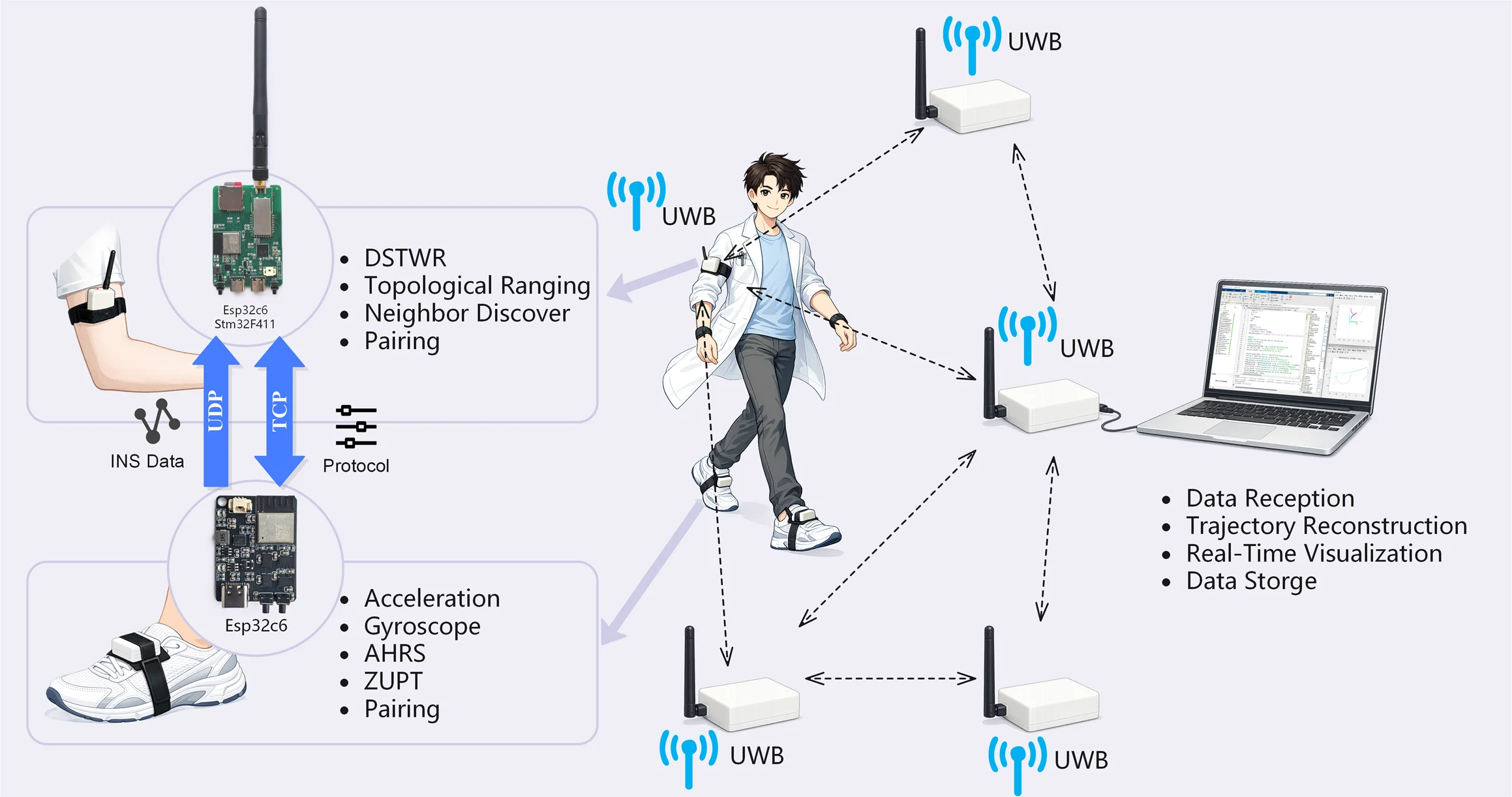
The system operates under completely anchor-free conditions — no base stations, no magnetometers, no prior position information. At startup (), Multidimensional Scaling (MDS) analytically recovers the relative spatial topology from UWB distance measurements alone. As users begin to move (), a spatiotemporal optimization jointly solves for global rotation and individual node azimuths while a dual-branch parallel strategy eliminates mirror ambiguity — the correct configuration yields residuals several orders of magnitude smaller than the incorrect mirror solution.
Field tests were conducted on a real hardware platform. The UWB module achieves a typical ranging accuracy of via Double-Sided Two-Way Ranging. The foot-mounted IMU provides robust local displacement increments through ZUPT (Zero Velocity Update) to suppress cumulative drift.
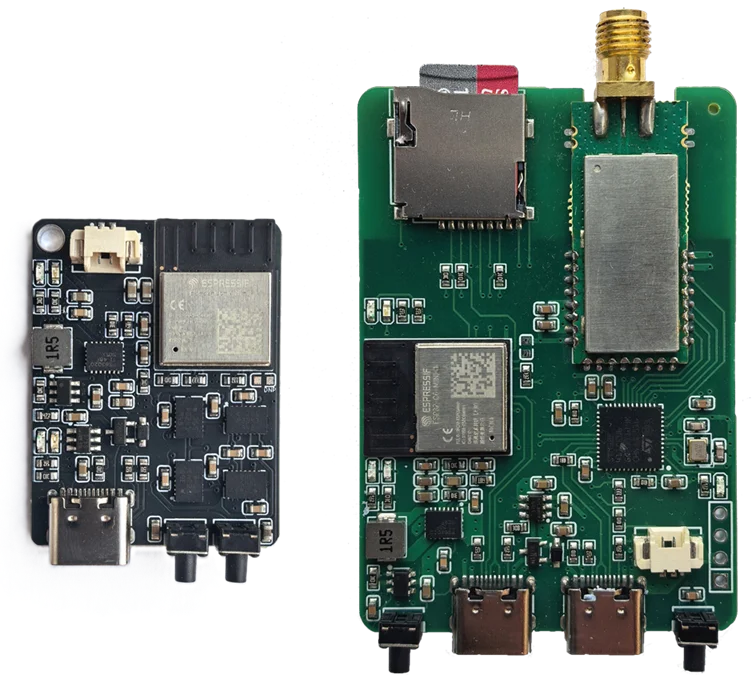
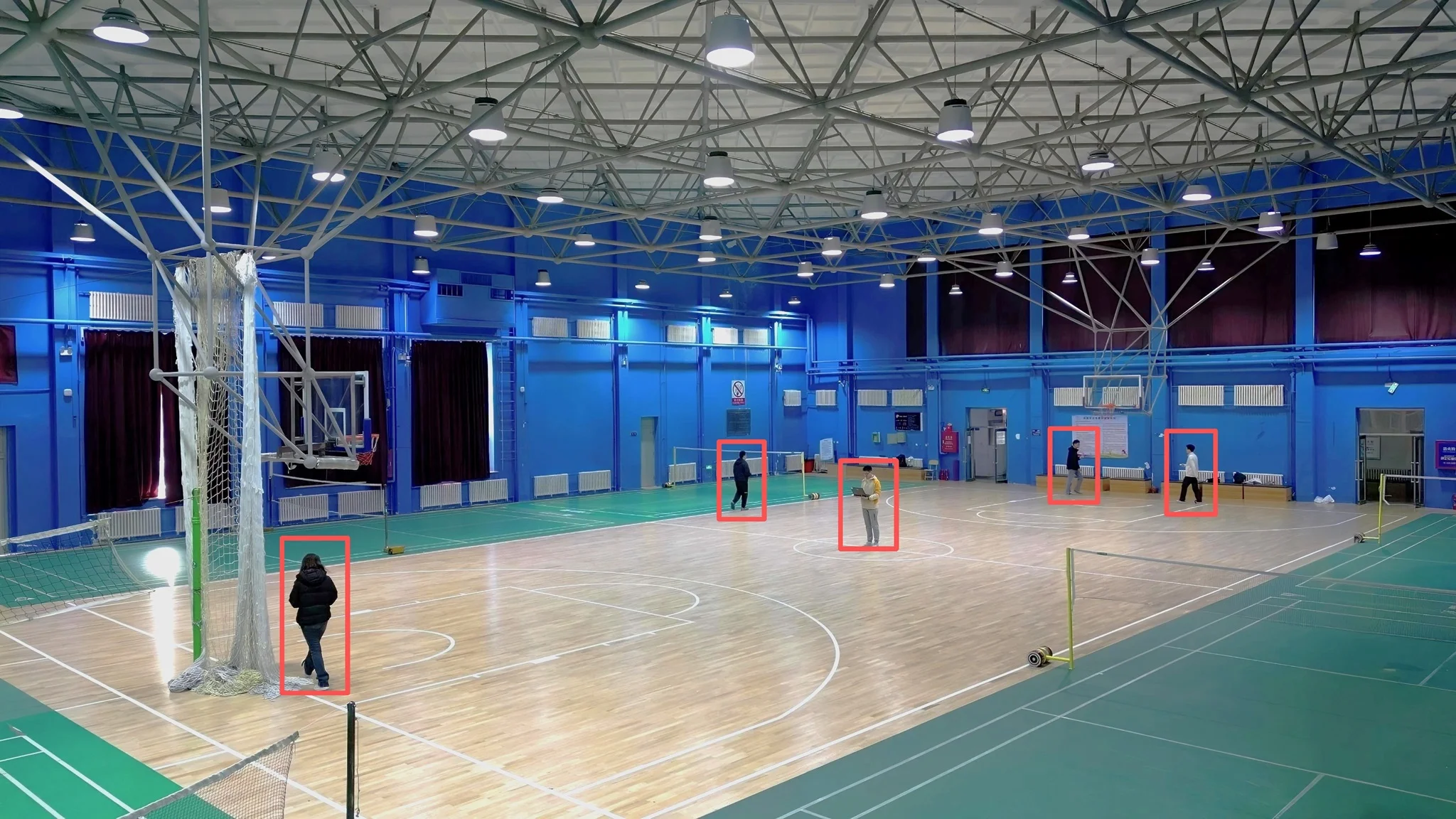
The experiment took place on a indoor basketball court with 5 subjects performing straight-line walking, right-angle turns, circular loops, and irregular maneuvers. The five nodes started from scattered positions with random initial orientations — no base stations or preset position information was available.
Throughout data collection, each node’s foot-mounted module independently ran INS algorithms. Displacement data and UWB ranging were aggregated at the master node, and after removing NLOS outliers, a multi-epoch observation sequence was constructed for reconstruction.
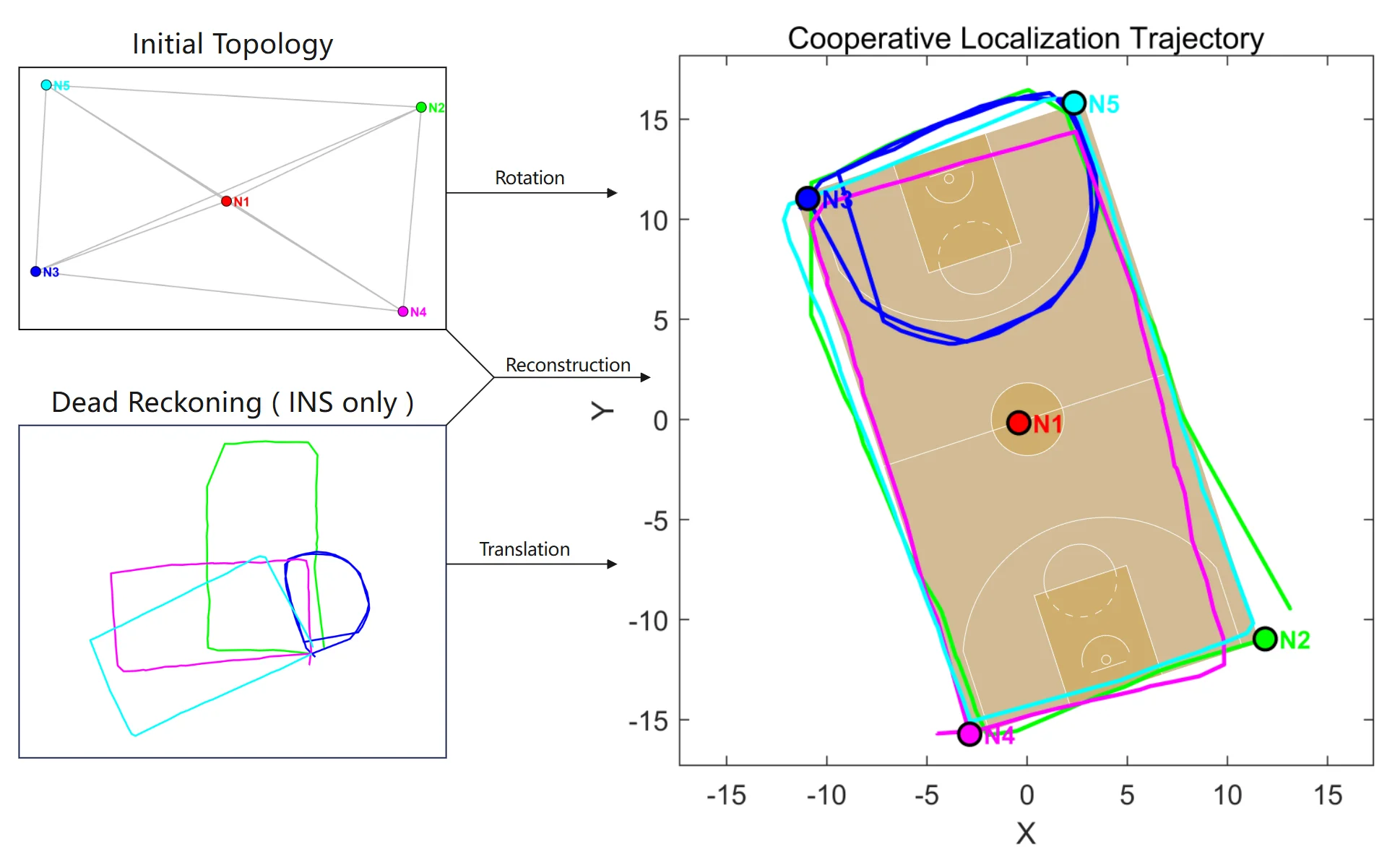
The results demonstrate that the algorithm successfully reconstructed continuous multi-node trajectories under real sensor noise, synchronization errors, and complex motion patterns — providing an autonomous initialization scheme for multi-device cooperative navigation in GNSS-denied environments.
NOTE📄 Paper: Anchor-Free Multi-Target Azimuth Auto-Alignment with UWB and IMU — IEEE Conference, 2026
Invalid admonition directive. (Admonition directives must be of block type ":::note{name="name"} <content> :::")
Joey0609 · 2026-05-08
CC BY-NC-SA 4.0https://joey0609.github.io/posts/005_anchor_free_auto_alignment/anchor_free_auto_alignment/